
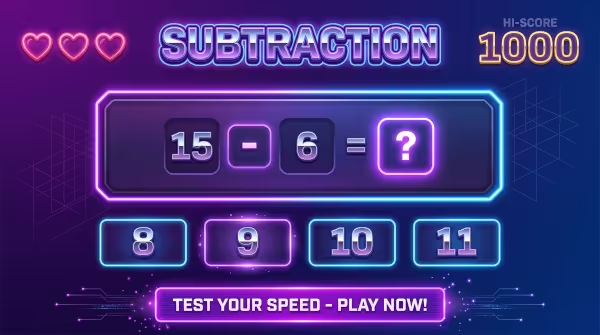
Subtraction Math Game
Learn subtraction and improve mathematical problem-solving through engaging games
How to Play
- 1Master subtraction to enhance mathematical skills
- 2Improve mental calculation speed and accuracy
- 3Strengthen logical reasoning and problem-solving
- 4Build confidence through progressive levels
Subtraction requires inverse reasoning, which the brain finds less intuitive than addition. Structured practice builds reliable mental strategies, counting up, decomposing into tens, until the process becomes automatic and effortless.
About This Game
Subtraction is cognitively harder than addition for most people because it requires working backwards from a result, a form of inverse reasoning that the brain finds less intuitive. The mental effort of reversing direction is compounded when regrouping (borrowing) is involved, which demands holding multiple partial values in working memory simultaneously. The Subtraction game builds this skill through structured practice, helping you develop reliable mental strategies for finding differences quickly and accurately.
Common strategies reinforced through play include counting up (adding from the smaller number to the larger), decomposing numbers into tens and units, and using known addition facts as anchors. Practising these approaches in short, fast rounds builds automaticity, the point where calculation no longer requires conscious effort and the answer arrives without deliberate reasoning steps.
Difficulty increases progressively from simple two-digit differences to problems requiring multi-step mental regrouping. Suitable for children at any stage of subtraction learning, students wanting to reduce careless errors in timed tests, and adults for whom mental arithmetic still feels effortful. Consistent short sessions produce faster improvement than occasional long practice, making this game ideal for daily five-minute warm-up routines.
Subtraction Math Game
Learn subtraction and improve mathematical problem-solving through engaging games
What this game trains and how it helps
Subtraction is cognitively harder than addition for most people because it requires working backwards from a result, a form of inverse reasoning that the brain finds less intuitive. The mental effort of reversing direction is compounded when regrouping (borrowing) is involved, which demands holding multiple partial values in working memory simultaneously. The Subtraction game builds this skill through structured practice, helping you develop reliable mental strategies for finding differences quickly and accurately.
Common strategies reinforced through play include counting up (adding from the smaller number to the larger), decomposing numbers into tens and units, and using known addition facts as anchors. Practising these approaches in short, fast rounds builds automaticity, the point where calculation no longer requires conscious effort and the answer arrives without deliberate reasoning steps.
Difficulty increases progressively from simple two-digit differences to problems requiring multi-step mental regrouping. Suitable for children at any stage of subtraction learning, students wanting to reduce careless errors in timed tests, and adults for whom mental arithmetic still feels effortful. Consistent short sessions produce faster improvement than occasional long practice, making this game ideal for daily five-minute warm-up routines.
How to Play
- Master subtraction to enhance mathematical skills
- Improve mental calculation speed and accuracy
- Strengthen logical reasoning and problem-solving
- Build confidence through progressive levels
Goal
Solve subtraction problems under time pressure. The game adapts difficulty so you train mental strategies for finding differences quickly.
Difficulty
Early levels use two-digit subtractions; later levels introduce regrouping and larger numbers. Difficulty and round length scale with your performance.
More games like this
Every game on PlayingMind targets a specific cognitive skill. Adaptive difficulty means the game adjusts to your level automatically, starting accessible and increasing the challenge as you improve. Each session takes two to five minutes.
- Cross NumbersA number crossword where every clue is math, solve intersecting digits across and down
- Carry the Chain: Fast Mental MathSolve quick equations where each answer becomes the next step. Train speed, accuracy, and focus as difficulty ramps up.
- Math BubblePractice fast arithmetic under pressure. Aim, shoot, and pop the bubbles that match the equation result.
- Math ComparisonPick the correct sign faster than the clock: <, =, or >.