
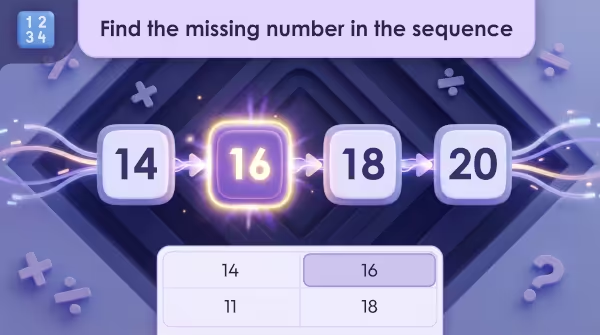
Number Sequence Game
Practice pattern recognition and logical thinking by completing number sequences
How to Play
- 1A sequence of numbers will appear with one missing
- 2Identify the pattern and find the missing number
- 3Choose from 4 possible answers
- 4Difficulty increases with longer sequences and larger steps
Rule induction from number sequences, forming a hypothesis from differences between terms, then testing it, is a foundational mathematical habit of mind that directly supports algebraic thinking and data pattern recognition.
About This Game
Number sequences are one of mathematics' most fundamental structures, and the ability to detect their underlying rules is a key component of numerical reasoning. In the Number Sequence game, you are shown a partial arithmetic sequence with one value hidden, and you must identify the step pattern to find the missing number. This task exercises rule induction, the same cognitive process used when recognising trends in data, extending patterns in algebra, or predicting outcomes from a series of observations.
The core reasoning process involves examining the differences between consecutive terms, forming a hypothesis about the generating rule, and applying it to the hidden position. Sequences become progressively more complex, with larger step sizes, longer chains, and missing positions placed at locations that require reasoning from both neighbours simultaneously, forcing a more sophisticated mental model of the entire sequence.
This game builds the habit of looking for mathematical structure in number sets, a disposition that directly supports algebra, data analysis, and any domain where recognising patterns leads to insight. The post-answer reveal reinforces learning even when the initial guess was incorrect, making errors into genuine teaching moments rather than wasted attempts. Suitable for students at all levels and adults who want to keep pattern-recognition skills sharp.
Number Sequence Game
Practice pattern recognition and logical thinking by completing number sequences
What this game trains and how it helps
Number sequences are one of mathematics' most fundamental structures, and the ability to detect their underlying rules is a key component of numerical reasoning. In the Number Sequence game, you are shown a partial arithmetic sequence with one value hidden, and you must identify the step pattern to find the missing number. This task exercises rule induction, the same cognitive process used when recognising trends in data, extending patterns in algebra, or predicting outcomes from a series of observations.
The core reasoning process involves examining the differences between consecutive terms, forming a hypothesis about the generating rule, and applying it to the hidden position. Sequences become progressively more complex, with larger step sizes, longer chains, and missing positions placed at locations that require reasoning from both neighbours simultaneously, forcing a more sophisticated mental model of the entire sequence.
This game builds the habit of looking for mathematical structure in number sets, a disposition that directly supports algebra, data analysis, and any domain where recognising patterns leads to insight. The post-answer reveal reinforces learning even when the initial guess was incorrect, making errors into genuine teaching moments rather than wasted attempts. Suitable for students at all levels and adults who want to keep pattern-recognition skills sharp.
How to Play
- A sequence of numbers will appear with one missing
- Identify the pattern and find the missing number
- Choose from 4 possible answers
- Difficulty increases with longer sequences and larger steps
Goal
Find the missing number in a sequence by spotting the pattern. Sequences get longer and the step rule more varied as you advance.
Difficulty
Sequences get longer and steps can be additive or multiplicative. Missing position may be in the middle or end.
More games like this
Every game on PlayingMind targets a specific cognitive skill. Adaptive difficulty means the game adjusts to your level automatically, starting accessible and increasing the challenge as you improve. Each session takes two to five minutes.
- Number SoupDrag through a digit grid to find hidden multi-digit targets in any straight line before time runs out. Combo scoring and endless levels.
- Arrow PathSlide pieces off the board in the direction of their arrows
- Arithmetic MazeNavigate through number mazes to reach target totals
- Grid Sum PuzzleEnhance mathematical reasoning through grid-based sum puzzles