
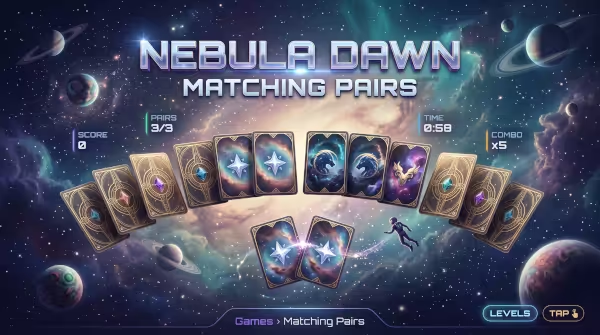
Matching Pairs Game
Practice memory and concentration by finding matching pairs
How to Play
- 1Cards are arranged face-down in a grid
- 2Flip two cards to reveal their emojis
- 3If they match, they will be removed
- 4If not, they flip back after a short delay
- 5Find all pairs to complete the challenge
Spatial memory for card positions exercises the visuospatial sketchpad, the component of working memory that holds mental maps. Systematic scanning strategies developed during play transfer to navigation, object retrieval, and spatial planning tasks.
About This Game
Matching Pairs is a spatial memory task: you flip cards to reveal emoji pairs, memorise their positions, and find all matches with the fewest flips. This trains both short-term visuospatial memory (remembering what was where) and attentional strategy (deciding which cards to prioritise on each turn to maximise information gained per flip). The combination of memory and strategy makes the game more cognitively demanding than purely memory-based tasks.
The cognitive challenge scales with grid size: a 2×2 grid with 4 pairs is manageable for most players, while a 6×6 grid with 12 pairs taxes spatial memory significantly and rewards players who develop systematic scanning strategies. Random guessing quickly becomes inefficient at larger grid sizes, pushing players toward deliberate encoding and recall, the same transition that marks the development of efficient memory strategy in children.
A critical skill the game builds is associative encoding, learning to bind content (the emoji) to location (where on the grid) rather than just recognising the content alone. This content-location binding is a specific form of episodic memory that underlies navigation, object placement, and spatial orientation in daily life. Players who improve at Matching Pairs often report that everyday spatial memory tasks, remembering where they placed objects, recalling room layouts, feel noticeably more reliable.
Matching Pairs Game
Practice memory and concentration by finding matching pairs
What this game trains and how it helps
Matching Pairs is a spatial memory task: you flip cards to reveal emoji pairs, memorise their positions, and find all matches with the fewest flips. This trains both short-term visuospatial memory (remembering what was where) and attentional strategy (deciding which cards to prioritise on each turn to maximise information gained per flip). The combination of memory and strategy makes the game more cognitively demanding than purely memory-based tasks.
The cognitive challenge scales with grid size: a 2×2 grid with 4 pairs is manageable for most players, while a 6×6 grid with 12 pairs taxes spatial memory significantly and rewards players who develop systematic scanning strategies. Random guessing quickly becomes inefficient at larger grid sizes, pushing players toward deliberate encoding and recall, the same transition that marks the development of efficient memory strategy in children.
A critical skill the game builds is associative encoding, learning to bind content (the emoji) to location (where on the grid) rather than just recognising the content alone. This content-location binding is a specific form of episodic memory that underlies navigation, object placement, and spatial orientation in daily life. Players who improve at Matching Pairs often report that everyday spatial memory tasks, remembering where they placed objects, recalling room layouts, feel noticeably more reliable.
How to Play
- Cards are arranged face-down in a grid
- Flip two cards to reveal their emojis
- If they match, they will be removed
- If not, they flip back after a short delay
- Find all pairs to complete the challenge
Goal
Flip cards to find matching pairs with as few turns as possible. You train visual memory and position encoding.
Difficulty
Grid size grows from 2×2 (4 pairs) up to 6×6 (12 pairs). Fewer flips and faster completion advance you.
More games like this
Every game on PlayingMind targets a specific cognitive skill. Adaptive difficulty means the game adjusts to your level automatically, starting accessible and increasing the challenge as you improve. Each session takes two to five minutes.