
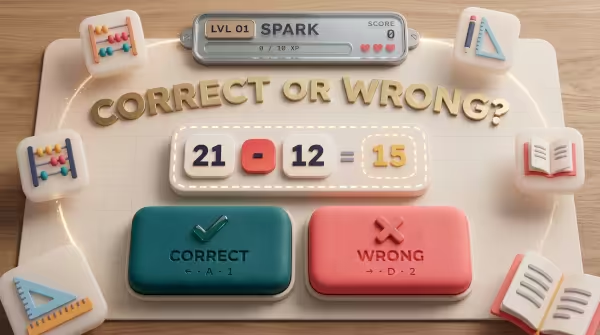
Correct or Wrong Game
Practice quick math verification by judging if equations are correct
How to Play
- 1An equation will appear on screen
- 2Quickly decide if the equation is correct or wrong
- 3Click "Correct" if true, "Wrong" if false
- 4Build speed and accuracy in mathematical verification
Equation verification trains estimation and heuristic checking: rounding to test plausibility, checking parity, spotting out-of-range results. These fast-check strategies are more valuable than exact calculation for catching errors quickly in real-world contexts.
About This Game
Correct or Wrong trains rapid equation verification, a skill meaningfully distinct from solving. Rather than computing an answer from scratch, you evaluate whether a presented result is plausible given the operands. This trains estimation, number sense, and the ability to detect arithmetic errors quickly, capabilities that are directly useful in testing, professional work, and everyday calculation.
Effective verification relies on a toolkit of fast mental checks: rounding both operands to estimate a plausible range, checking parity (an even number multiplied by anything must yield an even result), and recognising when a result is so far outside reasonable bounds that no detailed check is needed. The game rewards players who develop and apply these heuristics over those who attempt exact calculation for every problem, which is both slower and more error-prone under time pressure.
This is a high-value skill for anyone who works with numbers professionally, takes timed exams that penalise wrong answers, or wants to catch arithmetic errors faster in everyday contexts. It is also an excellent entry point for beginners, because it requires less computation than solving while building the same number intuition. Regular players develop a reliable sense of when an answer 'looks wrong', an instinct that is hard to teach directly but emerges naturally from deliberate verification practice.
Correct or Wrong Game
Practice quick math verification by judging if equations are correct
What this game trains and how it helps
Correct or Wrong trains rapid equation verification, a skill meaningfully distinct from solving. Rather than computing an answer from scratch, you evaluate whether a presented result is plausible given the operands. This trains estimation, number sense, and the ability to detect arithmetic errors quickly, capabilities that are directly useful in testing, professional work, and everyday calculation.
Effective verification relies on a toolkit of fast mental checks: rounding both operands to estimate a plausible range, checking parity (an even number multiplied by anything must yield an even result), and recognising when a result is so far outside reasonable bounds that no detailed check is needed. The game rewards players who develop and apply these heuristics over those who attempt exact calculation for every problem, which is both slower and more error-prone under time pressure.
This is a high-value skill for anyone who works with numbers professionally, takes timed exams that penalise wrong answers, or wants to catch arithmetic errors faster in everyday contexts. It is also an excellent entry point for beginners, because it requires less computation than solving while building the same number intuition. Regular players develop a reliable sense of when an answer 'looks wrong', an instinct that is hard to teach directly but emerges naturally from deliberate verification practice.
How to Play
- An equation will appear on screen
- Quickly decide if the equation is correct or wrong
- Click "Correct" if true, "Wrong" if false
- Build speed and accuracy in mathematical verification
Goal
Decide whether each equation is correct or wrong as quickly as you can. The goal is to build fast verification and estimation, not full calculation.
Difficulty
Equations range from simple to multi-step. Time pressure encourages estimation and parity checks rather than full calculation.
More games like this
Every game on PlayingMind targets a specific cognitive skill. Adaptive difficulty means the game adjusts to your level automatically, starting accessible and increasing the challenge as you improve. Each session takes two to five minutes.
- Cross NumbersA number crossword where every clue is math, solve intersecting digits across and down
- Carry the Chain: Fast Mental MathSolve quick equations where each answer becomes the next step. Train speed, accuracy, and focus as difficulty ramps up.
- Math BubblePractice fast arithmetic under pressure. Aim, shoot, and pop the bubbles that match the equation result.
- Math ComparisonPick the correct sign faster than the clock: <, =, or >.